AI as clinical labor · Conceptual framework v1.0
The Healthcare AI Labor Stack
A thought framework for where AI enters the work of healthcare—and what a more capable clinical workforce could make possible.
Healthcare AI can be understood as a new form of clinical labor: the performance of bounded tasks within clinical and operational workflows. Delegating a task does not transfer professional or organizational accountability to a machine.
Start with the work
Healthcare AI discussions often begin with models, copilots, and applications. This framework starts with a broader question: how might AI change the work itself? Model capability matters, but so does connecting that capability to the people, knowledge, and workflows that deliver care.
The Healthcare AI Labor Stack organizes that work into seven overlapping functions. This is a conceptual map, not a validated taxonomy, maturity scale, or ranking of clinical value. A workflow may use several functions, loop between them, or need only one. More layers do not automatically mean more value.
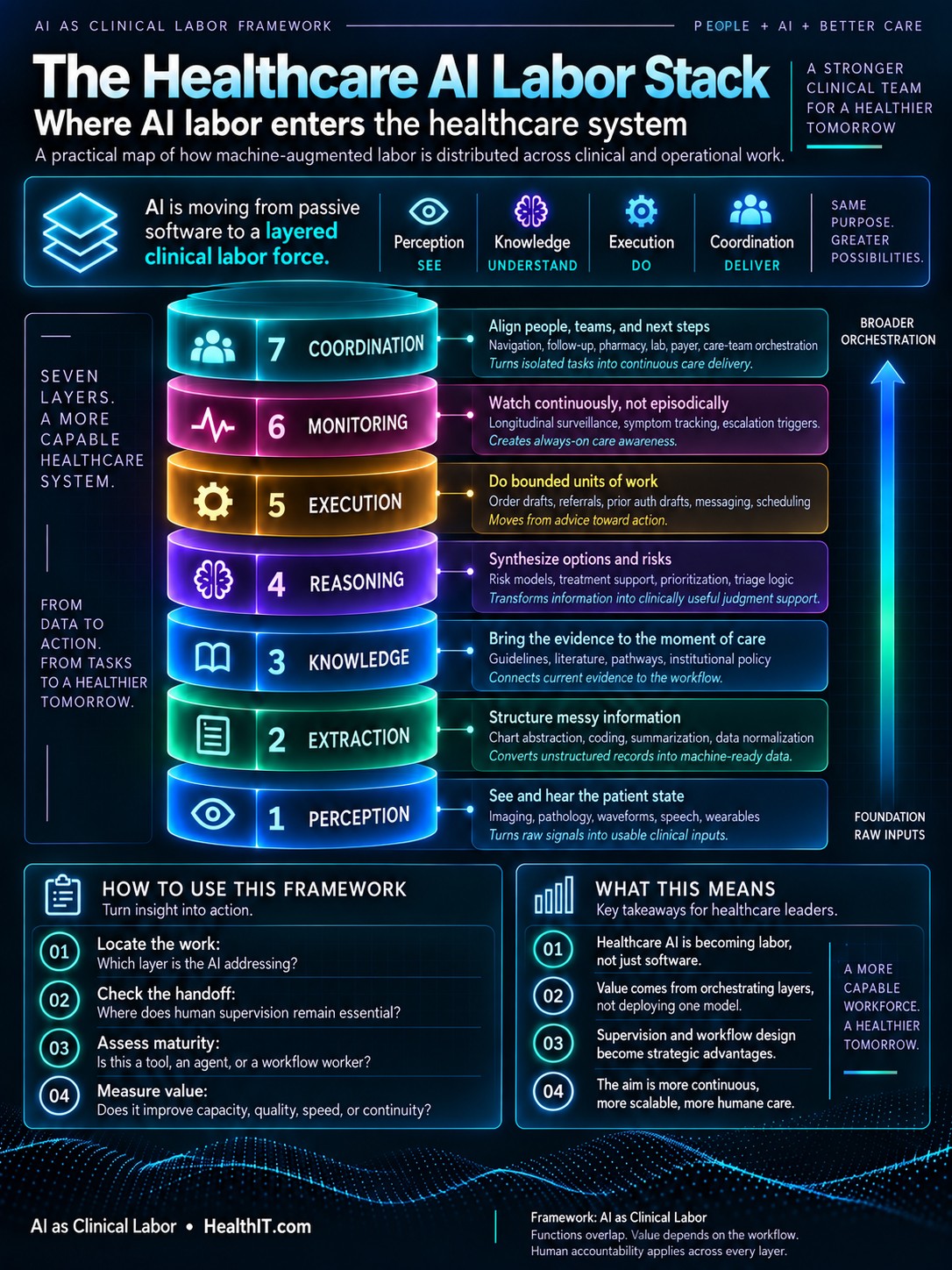
Seven functions, seven useful questions
1Perception
Interpret images, pathology, waveforms, speech, and wearable signals as inputs to care.
What can the system miss when the signal is poor?
2Extraction
Turn unstructured records into structured information through abstraction, summarization, and normalization.
Can each important finding be traced to its source?
3Knowledge
Retrieve relevant guidelines, literature, pathways, and institutional policy within the workflow.
Is the evidence current and applicable here?
4Reasoning
Synthesize information, options, risks, and uncertainty to support human decisions.
What would change the recommendation?
5Execution
Perform bounded, authorized tasks such as drafting documentation, routing referrals, or scheduling.
Which actions require review before they occur?
6Monitoring
Track change over time and surface concerns through defined follow-up and escalation rules.
Who responds, and what happens when nobody does?
7Coordination
Connect patients, clinicians, pharmacies, laboratories, payers, and care teams around the next action.
How do we know the handoff actually closed?
What this could make possible
Clinical expertise could become more accessible through bounded support that brings relevant knowledge into more workflows. Independent tasks could run in parallel, with controlled handoffs connecting their results. Follow-up could become more continuous when someone owns the response to what the system finds.
These are strategic possibilities, not demonstrated outcomes of this framework. Realizing them depends on how organizations combine the layers. Supervision and workflow design may become strategic advantages: determining where machines extend human capacity, where people exercise judgment, and how the whole team works together.
The purpose is to build a more capable clinical workforce in which people and machines contribute what they do best. Same purpose. Greater possibilities.
Follow a workflow across the stack
Consider a hypothetical referral workflow. Extraction structures the referral information. Knowledge retrieves local referral criteria. Reasoning flags missing information for staff review. Execution prepares an authorized scheduling task. Monitoring detects that it remains incomplete. Coordination routes the unresolved handoff to the responsible team.
This example describes a possible design, not an implemented system or evidence of benefit. Each transition needs an owner, a source record, and a defined response to uncertainty. An accurate summary is of little use if it reaches the wrong queue or creates another task that nobody owns.
Evaluate the whole burden
My recommendation is to begin with one recurring workflow and a measurable problem. Count the work removed and the work introduced: supervision, correction, integration, training, exceptions, and maintenance. Faster generation can still leave the team with more work overall.
- What exact task is delegated, and what remains with the clinician or team?
- Which inputs, permissions, and review steps are required before action?
- Who catches failures, handles escalation, and can stop the workflow?
- Compared with current practice, what changes in total staff time, errors, delays, and unresolved handoffs?
- What evidence would justify continuing, changing, or stopping the pilot?
The opportunity is a more capable workforce. Whether any particular design delivers that requires evaluation in its intended setting. Workflow design and supervision deserve the same attention as model selection.
Evidence and scope
This is an original HealthIT conceptual framework. It makes no claim of improved clinical outcomes or regulatory suitability. DECIDE-AI (Vasey and colleagues, Nature Medicine, 2022) supports attention to human factors and early clinical evaluation; it does not validate this seven-function taxonomy.
Use the evaluation worksheet to document a specific use case. Share a source-backed correction or practical observation to help refine the framework.